
What if working on projects at the same time. Slowly and carefully. Was actually the secret to your most creative ideas?
Most people think multitasking hurts focus.. They’re right. About the fast switching kind.. There’s a different way that historys most creative minds used. Its called slow motion multitasking and it might change how you think about creativity.
What Is Slow Motion Multitasking?
Slow motion multitasking isn’t about doing everything at once. It’s about keeping meaningful projects going at the same time. Switching between them over days, weeks or months. So each one benefits from the ideas generated by the others.
Economist Tim Harford, who made this concept popular put it simply: the creative people don’t focus on one thing. They let ideas from areas cross-pollinate over time.
Einstein, Darwin and Parallel Thinking
Charles Darwin didn’t just work on On the Origin of Species. His journals show a man studying things at the same time. Barnacles, coral reefs, plant behavior and pigeon breeding. These weren’t distractions. In fact, they were inputs. Each area informed the others in ways that focusing on one thing never could.
Albert Einstein while making his theories of relativity was also writing on philosophy playing violin and exploring problems in thermodynamics. The connections he made across areas weren’t accidental. Ultimately, they were the result of a mind allowed to wander.
The pattern is consistent: exploring many areas generates connections and those connections are where original ideas live.
Why It Works: The Science of Creative Incubation
Research in psychology shows that creative breakthroughs rarely happen during intense focused work sessions. They happen during incubation. The period when the brain is working on a problem in the background while you’re engaged in something else.
Slow motion multitasking creates incubation by design. When you step away from one project to work on another your subconscious keeps processing. When you return you often see it with fresh eyes. And fresh solutions.
This is why a walk, a project or even an unrelated hobby can unlock what hours of staring at a screen cannot.
How to Apply Slow Motion Multitasking to Your Work
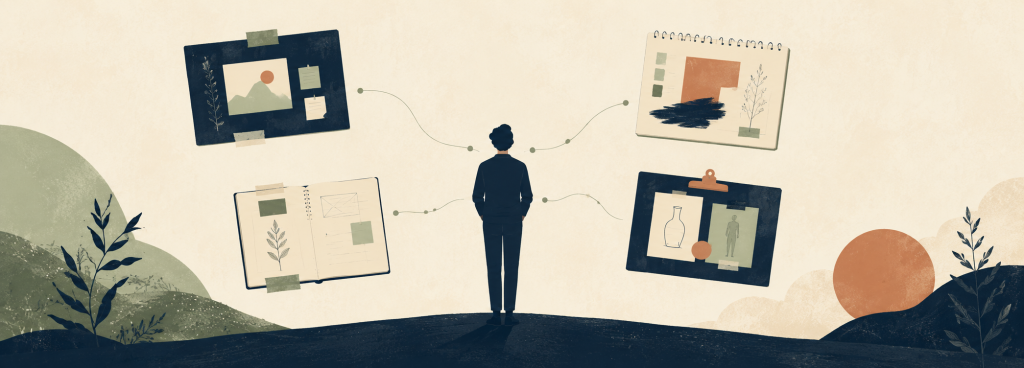
You don’t need to be Darwin to use this method. Here’s a practical starting framework:
a) Keep 2-4 projects at different stages. Not all at the intensity. Some are in exploration some in execution some in reflection.
b) Switch deliberately, not reactively. Set time blocks for each project than jumping between them impulsively. The goal is depth in each session not speed across all of them.
c) Look for connections between projects. Keep a note. Physical or digital. Where you log insights from one project that might apply to another. As a result, this is where the real creative value compounds.
d) Protect your incubation time. Walks, downtime and even boredom are productive. Don’t optimize them away.
What This Means for Your Business or Creative Vision
If you’re someone with ideas. A business concept alongside a creative project, a brand strategy alongside a product launch. In reality you’re not scattered. You might just be wired for slow motion multitasking.
The challenge isn’t having ideas. Its having the structure to develop all of them without losing momentum on any. If you’ve ever felt like your business needed a real upgrade — not just a tweak — this might resonate with you.
Where Structure Meets Creative Vision
At Freehandesign we work with entrepreneurs, founders and creative professionals who are building more than one thing. Helping them bring clarity, strategy and execution to complex multi-layered visions.
If you’re ready to transform your ideas into well-designed ventures, let’s talk.
What projects are you currently juggling? Do you think you are a slow motion multitasker, without even knowing it?